
The digital age has brought about a major shift in the areas of communication, marketing, entertainment, and educational graphics. Among the various areas of graphic activities in the digital age are two of the most commonly used graphic techniques: CGI and Motion Graphics. This blog will tell you what is the Difference Between CGI and Motion Graphics. You will learn the definition, characteristics, and use of both terms.
What is CGI?
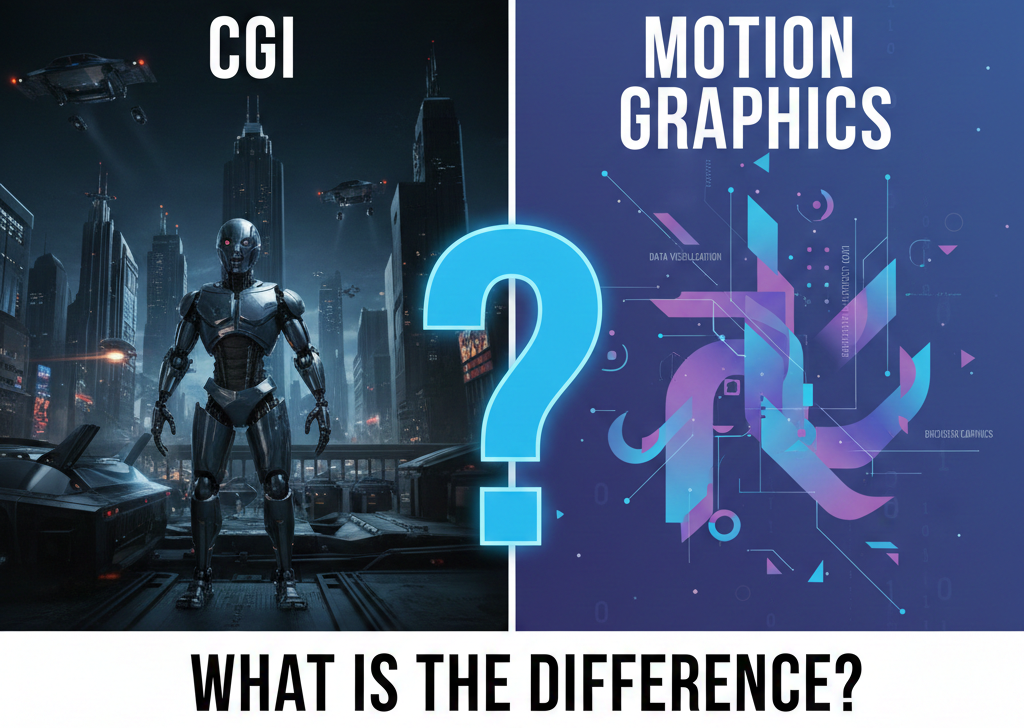
“CGI” is short for “Computer-Generated Imagery.” Computer-generated visuals are pictures generated partly or fully by computer software. Computer-generated images are used to produce real-like images, characters, and objects, as well as special effects, to resemble reality as closely as possible.
CGI is used in many films, web series, advertisements, and video games. In fact, CGI is used to depict scenarios that cannot be filmed or would be difficult or costly to shoot.
An important aspect to note about the distinction between CGI and motion graphics is that realism is very prominent in CGI. Illuminations, textures, darkness, and physics simulation come together in an image to ensure that it appears natural.
What are Motion Graphics?
Motion graphics include animated graphics like text, shapes, icons, and graphics, amongst others. These graphics tend to be flat or semi-flat, with an emphasis on communication as opposed to realism.
Motion graphics can be used for creating explainer videos, presentations, social media, and corporate videos. They also help to describe concepts, information, and stories effectively and simply.
To better comprehend what separates CGI and motion graphics, it should be noted that the latter is more design-related than creating realistic characters or environments.
Difference in Cost During Production of Both CGI and Motion Graphics
CGI differs from motion graphics in its intention and visual effect. CGI is employed for creating real graphics, while motion graphics are employed for communication of information.
CGI could include 3D models, high-end rendering, and elaborate animation. However, motion graphics could include 2D figures, smooth transitioning, and simplicity in terms of animation, which could involve text.
Another point of differentiation between CGI and motion graphics is the detail involved in each. CGI demands more time and processing because it is realistic in nature. On the other hand, motion graphics are simpler and more designer-oriented.
Difference Between CGI and Motion Graphics onthe Basis of Use
The use of CGI is prevalent in movies, TV shows, gaming, and high-end commercials. CGI is useful for creating an immersive effect for the viewer.
Motion Graphics: Motion graphics have been widely used in the fields of marketing, branding, education, and corporate communications. These graphics are useful in explaining an idea, presenting data, or effectively highlighting services.
As businesses comprehend the distinction between CGI and motion graphics,they can select the graphics that will best suit their content requirements.
CGI vs Motion Graphics Animation Style Differences
There is also a difference in the style of animations that can be seen in CGI and motion graphics. Animations in CGI are usually character-based or environment-based and very detailed.
Motion graphics designs are centered around smooth transitions, motion typography, and rhythm. Motion graphics are not meant to appear realistic but are meant to appear clean, modern, and interesting.
Complexity Difference Between CGI and Motion Graphics in Complexity
CGI projects tend to be more complex. They include modeling, texturing, lighting, and compositing. As such, the process of creating CGI takes longer compared to traditional animation.
Comparisonally speaking, motion graphics are less complex. The graphic design process alone qualifies them for the quick-turnaround projects they are often used for.
This disparity between the use of CGI and motion graphics also impacts the application of the two.
When to Use CGI?
The use of CGI is advisable whenever you require realistic graphics, visual effects, or imaginary situations. The use of CGI is ideal for storytelling, visual effects, and effective advertisements.
“If your project demands realism or fantasy, CGI is the solution.”
Applications of Motion Graphics
Motion graphics are best for purposes of explanation, information, or promotion. Motion graphics can be used in making explainer videos, product demos, social media posts, and presentations.
If clarity and communication take precedence over realism, then motion graphics would be the better choice.
Which is Better: CG or Motion Graphics?
It is hard to say which one is better. It entirely depends on the project requirement. Knowledge about the difference between CGI and motion graphics assists in choosing the proper strategy.
Additionally, some projects incorporate both methods. The two may be applied jointly to generate visual and informative content.
Conclusion
Knowing the difference between CGI and motion graphics is crucial for ensuring the choice of the correct visual effects style for your project. Both styles have their unique advantages as well as applications. The choice of which style is appropriate for use relies on whether your project aims for realism, pictorial narration, or efficient communication.
Framexentertainment is an entire visual production house focusing on Ad Films, CGI & VFX Videos, UGC Ads, Music Videos, Fashion & Product Shoots, Corporate Films, Documentaries, and Short Films.
Frequently Asked Questions (FAQs)
What is the basic distinction between CGI and motion graphics?
The basic distinction between CGI and motion graphics regards the fact that CGI is concerned with realistic graphics, while motion graphics are concerned with animated design elements.
Is CGI always 3D?
It is chiefly known in relation to 3D graphics. However, it can comprise the most advanced 2D computer graphics.
Are motion graphics easier to produce compared to CGI?
Actually, motion graphics are easier and faster to produce compared to CGI since they are less complicated.
Can CGI, Motion Graphics, and animation be mixed?
Well, yes, many projects include CGI and motion graphics in order to create interesting and informative visuals.
Which is preferable for video marketing?
Motion graphics may be more suited to marketing videos, while CGI graphics may be more suited to movie graphics.