
Computer-generated imagery, commonly known as CGI, has completely changed the entertainment industry. From creating simple digital graphics in early films to building entire virtual worlds today, CGI has become one of the most powerful tools in filmmaking. The Evolution of CGI: From Early Films to Today is a story of creativity, technology, and innovation that continues to shape how audiences experience movies, television, advertising, and games.
Today, CGI is everywhere. Whether it’s superheroes flying through cities, realistic dinosaurs walking on Earth, magical fantasy kingdoms, or lifelike animated characters, CGI helps bring impossible ideas to life. Let’s explore how this amazing technology has evolved over the years.
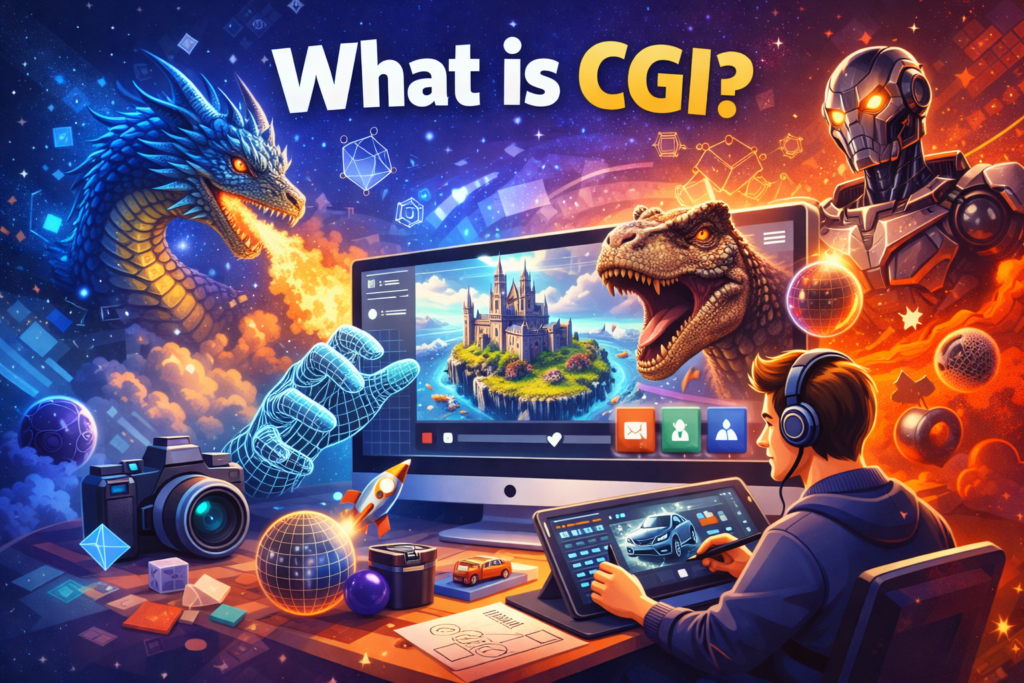
What is CGI?
CGI stands for Computer-Generated Imagery. It refers to images, animations, or visual effects created using computers instead of traditional filming techniques.
CGI is commonly used in:
Movies
Television shows
Advertisements
Video games
Architecture visualization
Product design
Medical simulations
Virtual Reality (VR)
The Beginning of CGI
The history of CGI started during the 1960s and 1970s when computers were first used to create simple graphics. These early digital images were basic wireframe models because computer processing power was very limited.
Researchers and engineers experimented with computer graphics mainly for scientific purposes before filmmakers realized their creative potential.
One of the earliest films to use computer-generated graphics introduced audiences to the possibility of digital visual effects, even though the graphics looked very simple compared to today’s standards.
CGI in the 1980s: The First Big Breakthrough
The 1980s marked an important milestone in The Evolution of CGI: From Early Films to Today. Computers became more powerful, allowing filmmakers to create smoother animations and better visual effects.
During this decade, CGI was mainly used for:
Space scenes
Digital backgrounds
Simple character animation
Mechanical objects
Visual transitions
Although CGI was still expensive and time-consuming, audiences were amazed by these new visual possibilities.
The 1990s: The Golden Age of CGI
The 1990s completely transformed the film industry. Computer graphics became much more realistic, making CGI a major part of filmmaking.
Several technological improvements helped CGI grow rapidly:
Better Computer Hardware
Faster processors and advanced graphics systems allowed artists to create detailed models and realistic animations.
Improved Animation Software
New software made it easier to design characters, environments, lighting, and textures.
Realistic Visual Effects
Filmmakers could now combine live-action footage with digital elements almost seamlessly.
This decade proved that CGI could create believable creatures, large-scale action scenes, and entire fantasy worlds.
How CGI Changed Animation
Animation experienced one of the biggest transformations during The Evolution of CGI: From Early Films to Today.
Earlier animated films were created by drawing every frame by hand. While beautiful, this process required enormous time and effort.
CGI introduced several advantages:
Faster production
Better character movement
Realistic lighting
Detailed textures
Dynamic camera angles
Large virtual environments
Today, many animated films are created entirely using computer graphics.
CGI in Modern Filmmaking
Modern filmmakers rely heavily on CGI to tell stories that would otherwise be impossible to film.
Some common applications include:
Creating Fantasy Worlds
Entire cities, planets, castles, forests, and oceans can now be digitally created.
Digital Characters
Monsters, aliens, robots, mythical creatures, and animated animals can all be brought to life using CGI.
Action Sequences
Dangerous explosions, collapsing buildings, flying vehicles, and massive battle scenes can be safely produced through digital effects.
Weather Effects
Rain, snow, storms, fire, smoke, and floods can all be generated digitally with impressive realism.
These innovations demonstrate The Evolution of CGI: From Early Films to Today and how digital tools have expanded creative possibilities.
CGI Beyond Movies
CGI is no longer limited to films.
Today it is widely used in:
Video Games
Modern games feature highly realistic characters, environments, and physics powered by advanced CGI.
Advertising
Brands use CGI to showcase products with eye-catching visuals that would be difficult to achieve through traditional filming.
Architecture
Architects create realistic building visualizations before construction begins.
Healthcare
Medical professionals use CGI for simulations, training, and educational videos.
Education
Teachers use CGI animations to explain scientific concepts, history, and engineering topics in engaging ways.
Technologies Behind Modern CGI
Today’s CGI combines several advanced technologies to produce incredibly realistic visuals.
3D Modeling
Artists build digital objects using specialized software.
Texturing
Textures add colors, patterns, and realistic surface details.
Lighting
Digital lighting creates shadows, reflections, and realistic environments.
Animation
Objects and characters are given natural movement.
Rendering
Rendering converts digital scenes into final high-quality images or videos.
Motion Capture
Actors perform real movements while cameras record them, allowing digital characters to move naturally.
Advantages of CGI
The popularity of The Evolution of CGI: From Early Films to Today is driven by numerous benefits.
Unlimited Creativity
Artists can create anything they imagine.
Improved Safety
Dangerous scenes can be created digitally without risking human lives.
Cost Efficiency for Large Productions
Building entire cities or creating huge action scenes physically can cost much more than digital production.
Flexibility
Changes can be made even after filming is complete.
Realistic Results
Modern CGI produces visuals that are often difficult to distinguish from reality.
Challenges of CGI
Despite its many advantages, CGI also has some limitations.
High Production Costs
Professional CGI requires expensive software and skilled artists.
Long Rendering Times
Complex scenes may take hours or even days to render.
Skilled Workforce
Creating realistic CGI demands experienced designers, animators, and technical experts.
Balance with Practical Effects
Overusing CGI can sometimes make scenes appear less natural if not executed carefully.
The Future of CGI
The future looks exciting for CGI.
Several emerging technologies are shaping the next generation of digital content:
Artificial Intelligence (AI)
Real-time rendering
Virtual Production
Augmented Reality (AR)
Virtual Reality (VR)
Cloud-based rendering
Digital humans
Interactive storytelling
Why CGI Continues to Grow
CGI continues to evolve because audiences expect better visual quality every year. Advances in computer technology allow creators to produce richer stories, more realistic effects, and unforgettable cinematic experiences.
As hardware becomes faster and software becomes smarter, CGI will become even more accessible for filmmakers, advertisers, educators, and businesses across different industries.
Conclusion
The Evolution of CGI: From Early Films to Today reflects one of the greatest technological achievements in visual storytelling. From simple wireframe graphics to breathtaking digital worlds, CGI has revolutionized entertainment and many other industries. As technology continues to advance, CGI will unlock even greater creative possibilities for the future.
For businesses and creators looking to produce high-quality visual content, Framexentertainment combines creativity with modern production techniques to deliver engaging and visually impressive projects.
Frequently Asked Questions (FAQs)
1. What does CGI stand for?
CGI stands for Computer-Generated Imagery, which refers to images and visual effects created using computer software.
2. When did CGI first appear in films?
CGI began appearing in films during the 1970s, with significant advancements occurring throughout the 1980s and 1990s.
3. Why is CGI important in filmmaking?
CGI allows filmmakers to create realistic visual effects, fantasy worlds, digital characters, and action scenes that would be impossible or too expensive to produce physically.
4. Is CGI only used in movies?
No. CGI is widely used in video games, advertising, architecture, education, healthcare, product visualization, and virtual reality.
5. What technologies are used in modern CGI?
Modern CGI uses 3D modeling, animation, rendering, texturing, lighting, motion capture, AI, and real-time rendering technologies.