
Documentaries are a very powerful form of visual storytelling, showing real events, people, cultures, and issues in a meaningfully engaging way. Unlike fiction films, documentaries are based on real life and intend to inform, educate, inspire, or raise awareness. With time, the art of documentary filmmaking has gotten more refined, with multiple styles and formats emerging. Understanding documentary types helps a viewer appreciate, or a creator understand, how stories get molded and represented.
This blog explains the major types of documentaries in simple, lucid language. Each type differs in its objectives, format, and storytelling methodology. Whether you’re a student, filmmaker, or simply a curious viewer, this guide will help you understand documentary filmmaking a little better.
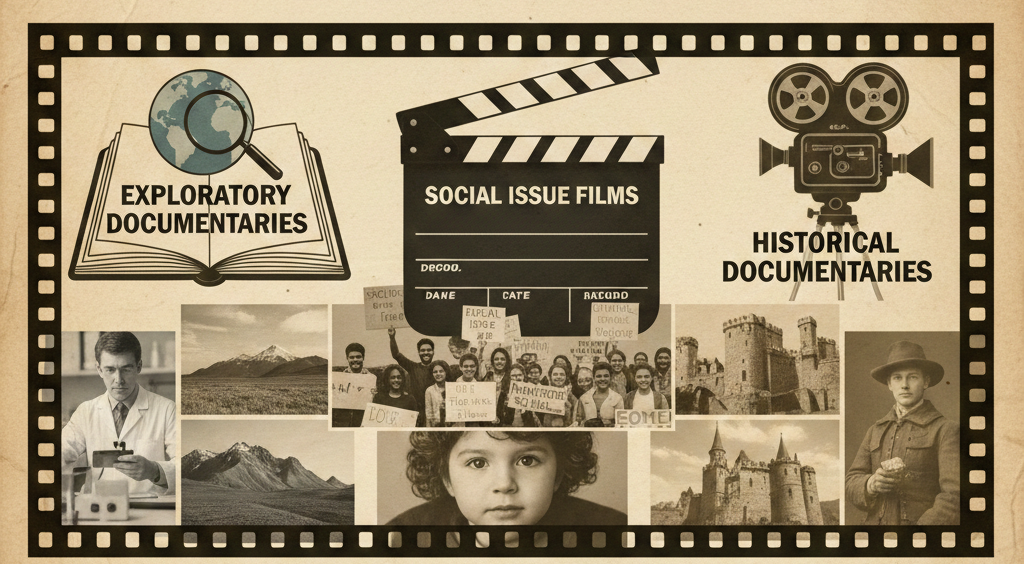
Expository Documentaries
The expository documentaries could probably be considered one of the oldest and most commonly used forms. These kinds of documentaries explain the subject directly to the viewer. They usually involve a narrator speaking over visuals that advance the story.
Documentary type focuses on facts, logic, and clear information. It includes a lot of archival footage, photographs, interviews, and graphics. Often, expository documentaries are used in educational programs, historical films, and television documentaries. Their main goal is to be informative for the audience and to persuade them with strong arguments and evidence.
Observational Documentaries
Observational documentaries are those dealing with the real-life situation as they usually occur. The filmmaker cannot interfere with or influence the subjects. It normally lacks narration, background music, or even direct interviews.
It acts like a silent observer in capturing events that are actually happening at the moment. This kind of documentary depicts realism; it makes situations look honest to the viewer. Observational documentary is done to show real life, social issues, and human behaviors in their natural form.
Participatory Documentaries
In a participatory documentary, the filmmaker gets to be part of the story. The director may interview the subjects, converse with them, or even appear onscreen with them.
It does help in establishing a personal relationship between the filmmaker and the topic. It allows viewers to see events through the filmmaker’s perspective. Participatory documentaries are often used for investigative stories, social issues, and personal journeys.
Reflexive Documentaries
Reflexive documentaries are the ones showing the very process of filmmaking. Instead of concealing the camera and methods of production, this form emphasizes them.
Such a documentary would remind its audience that it is, in fact, a documentary and that reality was shaped through editing, framing, and choices in storytelling. A reflexive documentary serves to engage the viewer with critical thinking regarding truth and reality in films.
Performed Documentaries
Performative documentaries have their underpinning in emotions and personal experiences. They focus less on naturalistic narration than on how an event actually changes people and their personal lives.
This genre typically involves personal accounts of experiences and recollections, along with artistic expression. A filmmaker’s feelings or point of view feature prominently in such a genre. Performative documentaries have proven to be effective means of articulating identity, trauma, culture, and personal struggles.
Poetic Documentaries
The poetic documentary is more concerned with mood and tone, with an emphasis on visual beauty, as opposed to a clearly defined narrative. They depend more on images, sounds, and rhythms that inspire emotions.
This type does not follow a traditional storyline, but rather it keeps the interpretation open to the audience. Poetic documentaries are often artistic and experimental, making them visually striking and emotionally deep.
Documentaries about history
Historical documentaries deal with events, movements, or personalities of the past. They are based on broad usage of archive footage, photos, documents, and interviews with experts.
The motivation is to teach the viewer about history in a fun and understandable way. These types of documentaries are needed in order to hold memories of culture and provide insight into current conditions.
Biographical Documentaries
Biographical films are about the life story of a real person. The subjects can be famous personalities, artists, leaders, or ordinary people with inspiring stories.
These are documentaries that express personal struggles, achievements, and life-changing moments. Interviews with family, friends, and experts help in creating a full picture of the subject’s life.
Socially Concerned Documentaries
Social issue documentaries emphasize fundamental problems of society, including poverty, inequality, the environment, education, and human rights.
Some of the other aims could be to raise awareness, create discussion, or bring about a change. Much of this can come through in interviews, real footage, and strong storytelling in the documentaries.
Documentaries about nature and wildlife
Nature and wildlife documentaries that incorporate stories about the natural world of animals and ecosystems. They show the beauty of nature, but at the same time educate viewers about environmental conservation.
They require patience, advanced filming techniques, and profound research. They are very important in spreading awareness about climate change and the protection of wildlife.
Importance of Various Documentary Types
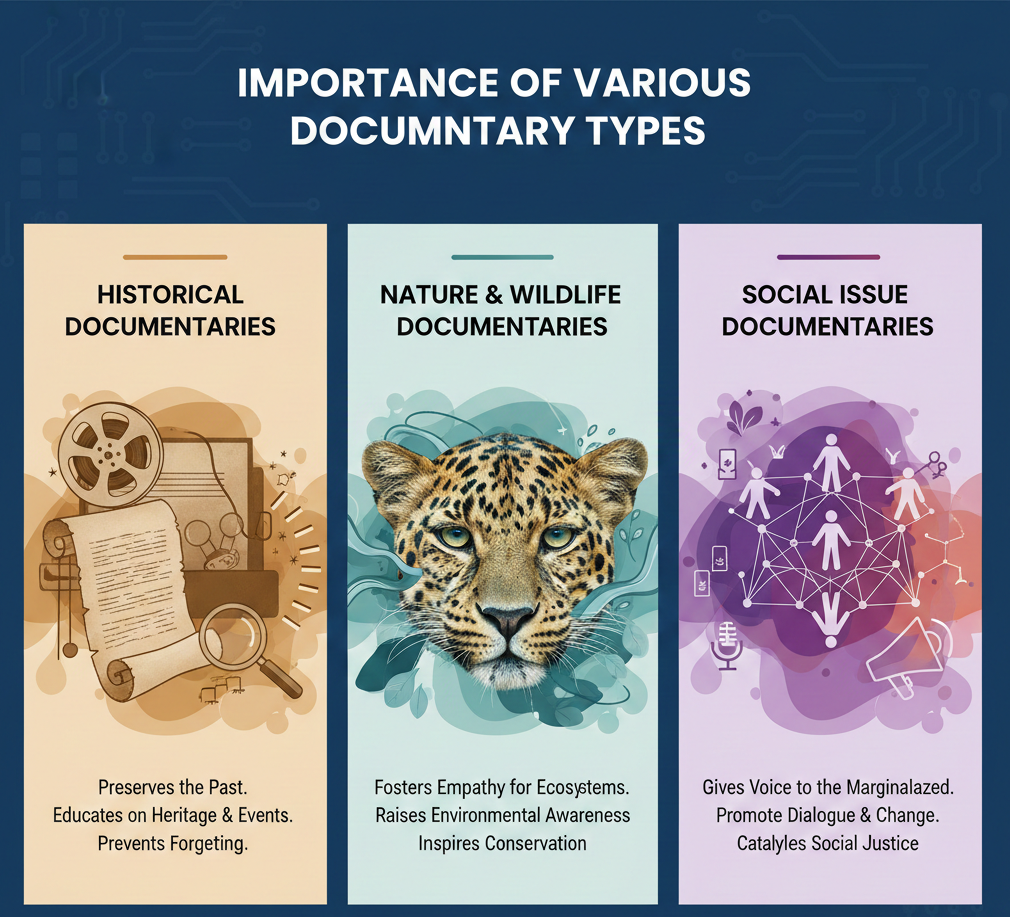
Each one would be serving a different purpose. Some will be informative, others observational, while some might be expressive or perceptual. Understanding these types helps filmmakers choose the right style for their story and helps viewers appreciate documentaries on a deeper level.
Conclusion
Documentaries are the most powerful medium in telling true stories with meaning. Each type of documentary offers unique ways of presenting reality, emotions, and truth. The choice of style depends on the story to be told, the intended purpose, and the audience. Framexentertainment is a full-service visual production house specialising in Ad Films, CGI & VFX Videos, UGC Ads, Music Videos, Fashion & Product Shoots, Corporate Films, Documentaries, and Short Films.
Frequently Asked Questions (FAQs)
What are documentaries?
Documentaries are non-fiction films that intend to show real events, people, or issues of the time to educate, inform, or inspire viewers.
How many types of documentaries are there?
They come in many forms: expository, observational, participatory, reflexive, performative, poetic, historical, biographical, social issue, and nature documentaries.
Which type of documentary is good for beginners?
Expository and observational documentaries are oftentimes more comprehensible for a starting author and easier to deal with.
Are documentaries always based on facts?
Of course, the basis of all documentaries is an event that really took place, but the style in which the story is told and the perspective from which it was taken can differ.
Why are documentaries important?
The documentary genre serves to spread awareness, preserve history, share real stories, and instigate social change.