
If you have ever watched a superhero movie, an animated film, or a creative commercial, you have probably wondered how those amazing visuals are made. Many people often confuse CGI vs VFX vs Animation: What’s the Difference? because these terms are closely related. However, they are not the same.
Understanding CGI vs VFX vs Animation is important for anyone interested in filmmaking, advertising, gaming, or digital content creation. Each technique has its own purpose, process, and creative possibilities.
In this guide, we will explain CGI vs VFX vs Animation: What’s the Difference? in simple language so that even beginners can easily understand.
Understanding CGI vs VFX vs Animation: What’s the Difference?
Before we compare them, let’s first understand what each term means.
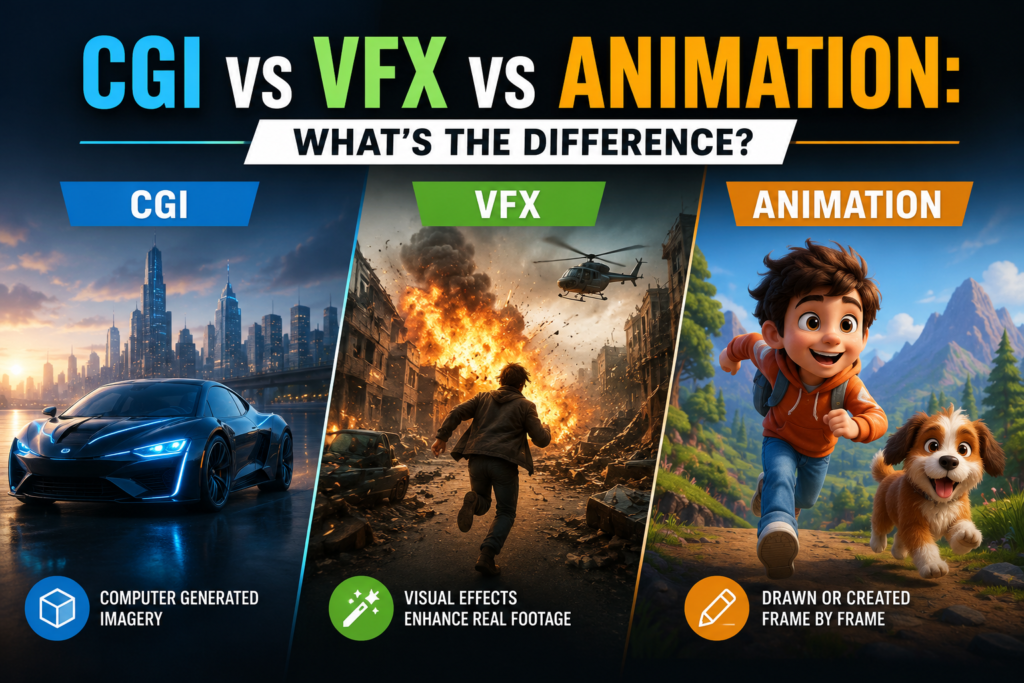
CGI stands for Computer-Generated Imagery.
It means creating images or objects entirely from computer software.
VFX stands for Visual Effects.
It means adding special effects to real-life footage after filming.
Animation is the process of making things move by using drawings, 2D graphics, 3D models, or stop-motion.
Even though these technologies often work together, they have different uses.

What is CGI?
CGI stands for Computer-Generated Imagery.
It is the process of making digital objects, characters, environments, or scenes using special computer programs.
Instead of building things physically, artists design them on computers.
Common uses of CGI include:
Animated movies
Video games
Product advertisements
Architectural visualizations
Automotive presentations
Virtual environments
Character creation
For example, a flying dragon in the sky might be created entirely with CGI, using no real object.
What is VFX?
Visual Effects (VFX) are used to combine real-life footage with computer-generated elements.
In VFX, filmmakers first film scenes with real actors.
Later, artists add effects like explosions, creatures, or futuristic cities.
Common uses of VFX include:
Action movies
Science fiction films
Fantasy movies
Television shows
Commercials
Music videos
For example, an actor standing in front of a green screen might later appear inside a spaceship using VFX.
What is Animation?
Animation is the process of making things move by using a sequence of images.
It doesn’t always need real-world footage.
Everything can be made from scratch.
There are different types of animation:
1.2D Animation
Characters and backgrounds are made in two dimensions.
Examples include:
Cartoon series
Educational videos
Explainer videos
2.3D Animation
Characters and objects have depth, making them look more real.
Examples include:
Animated films
Product demonstrations
Video games
3.Motion Graphics
These focus on animated text, icons, and graphics, not characters.
They are used in:
Business presentations
Corporate videos
Social media content
Advertisements
4.Stop Motion Animation
Physical objects are moved slightly between each photo to create movement.
Popular examples include clay animation and puppet animation.
CGI vs VFX vs Animation: What’s the Difference?
Understanding the difference between CGI, VFX, and animation gets easier when looking at their main purposes.
Feature | CGI | VFX | Animation
Uses real footage | Sometimes | Yes | Usually No
Computer-created content | Yes | Yes | Yes
Real actors required | Not always | Yes | Usually No
Main purpose | Create digital objects | Enhance live-action footage | Create movement
Used in films | Yes | Yes | Yes
Used in games | Yes | Rarely | Yes
How CGI and VFX Work Together
Many people think CGI and VFX are the same.
But CGI is often part of VFX.
For example:
A movie records actors on a green screen.
Artists create a giant dinosaur using CGI.
VFX combines the dinosaur with the live-action footage.
In this case:
CGI creates the dinosaur.
VFX places it into the movie scene.
Real-Life Examples
Examples make it easier to understand the difference between CGI, VFX, and animation.
Example 1: Animated Movie
Everything, from characters to backgrounds, is made digitally.
Main technology: Animation and CGI.
Example 2: Superhero Movie
Actors perform in front of cameras.
Later, effects like explosions and flying vehicles are added.
Main technology: VFX and CGI.
Example 3: Product Advertisement
A smartphone rotates in the air while graphics explain its features.
Main technology: CGI and Motion Graphics Animation.
Example 4: Educational Video
Characters explain scientific concepts using animated visuals.
Main technology: 2D Animation and Motion Graphics.
Advantages of CGI
CGI offers many creative possibilities.
Benefits include:
Realistic visuals
Unlimited creative freedom
Safe production of dangerous scenes
Cost-effective for impossible environments
Easy editing and changes
Reusable digital assets
Advantages of VFX
Visual Effects make movies and ads more exciting.
Benefits include:
Realistic action scenes
Seamless integration of digital elements
Safer filming
Time-saving compared to practical effects
Improved storytelling
Advantages of Animation
Animation is one of the most versatile ways to tell a story visually.
Benefits include:
Suitable for all ages
Explains complex ideas simply
Unlimited imagination
Attractive visual style
Effective for marketing and education
When to Use CGI
Choose CGI when you need:
Digital products
Virtual characters
3D environments
Architectural walkthroughs
Product visualization
When to Use VFX
Choose VFX when your project includes:
Live actors
Green screen footage
Impossible action scenes
Weather simulations
Fantasy creatures
Digital backgrounds
When to Use Animation
Animation is the best choice for:
Explainer videos
Educational content
Marketing videos
Cartoon series
Business presentations
Social media videos
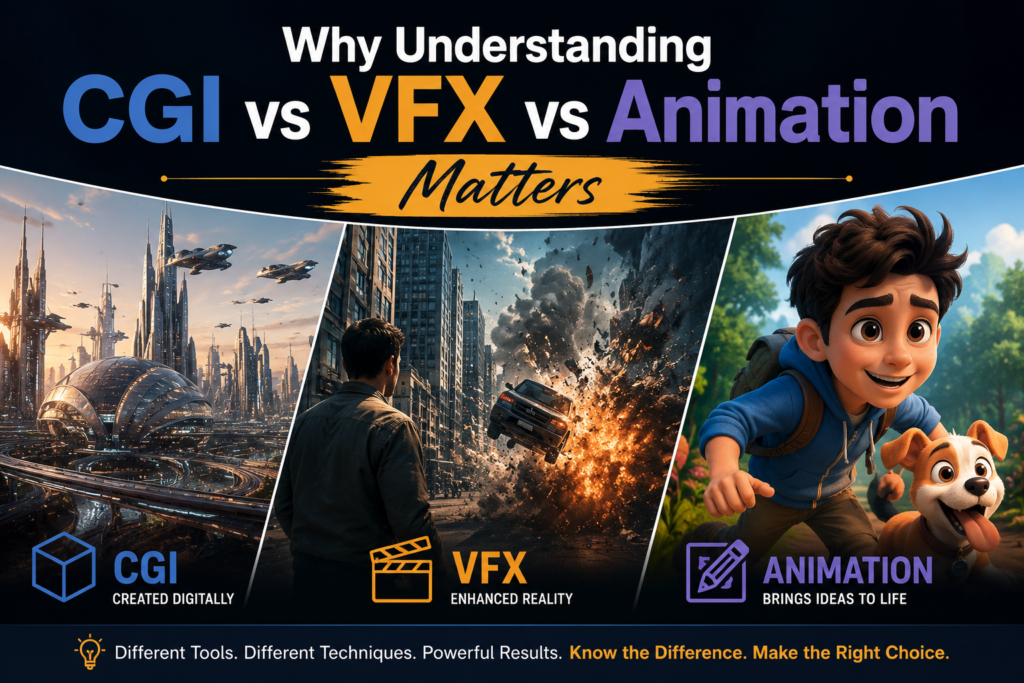
Why Understanding CGI vs VFX vs Animation Matters
Knowing the difference between CGI, VFX, and animation helps businesses, filmmakers, marketers, and creators choose the right technique for their projects.
Whether making a movie, ad, educational video, or product presentation, the right visual approach can improve storytelling and audience engagement.
Understanding these differences also helps clients communicate better with production teams.
Conclusion
Now you clearly understand the difference between CGI, VFX, and animation.
While these technologies are closely related, each has a unique purpose. CGI focuses on creating digital elements, VFX enhances real-life footage with CGI effects, and animation brings characters, objects, and stories to life through motion. The right choice depends on the project’s goals, style, and audience.
If you’re looking for professional visual storytelling, Framexentertainment combines creativity, technology, and experience to create high-quality CGI, VFX, and animation content.
Frequently Asked Questions
What is the main difference between CGI and VFX?
CGI creates digital elements, while VFX combines them with live-action footage.
Is CGI part of VFX?
CGI is often used within VFX to create digital characters, environments, and effects.
Is animation the same as CGI?
No animation is the process of making movement, while CGI is one method used in animation.
Which industries use CGI, VFX, and animation?
These technologies are widely used in films, TV, gaming, advertising, education, architecture, healthcare, and product marketing.
Can CGI, VFX, and animation be used together?
Modern films and ads often combine all three to create realistic and engaging visuals.