
CGI is an abbreviation for Computer-Generated Imagery. It can be any image or video created using computer software as opposed to being recorded using a camera. In simple terms, CGI can be described as the process involved in making visuals using a computer.
These days, CGI is all around us. Right from Hollywood productions to advertisements, video games, social media clips, and even educational films, CGI is a prominent part of visual storytelling. Every time you view something on screen that is real but technically impossible or very difficult to capture on film, there is a high possibility of CGI being incorporated there.
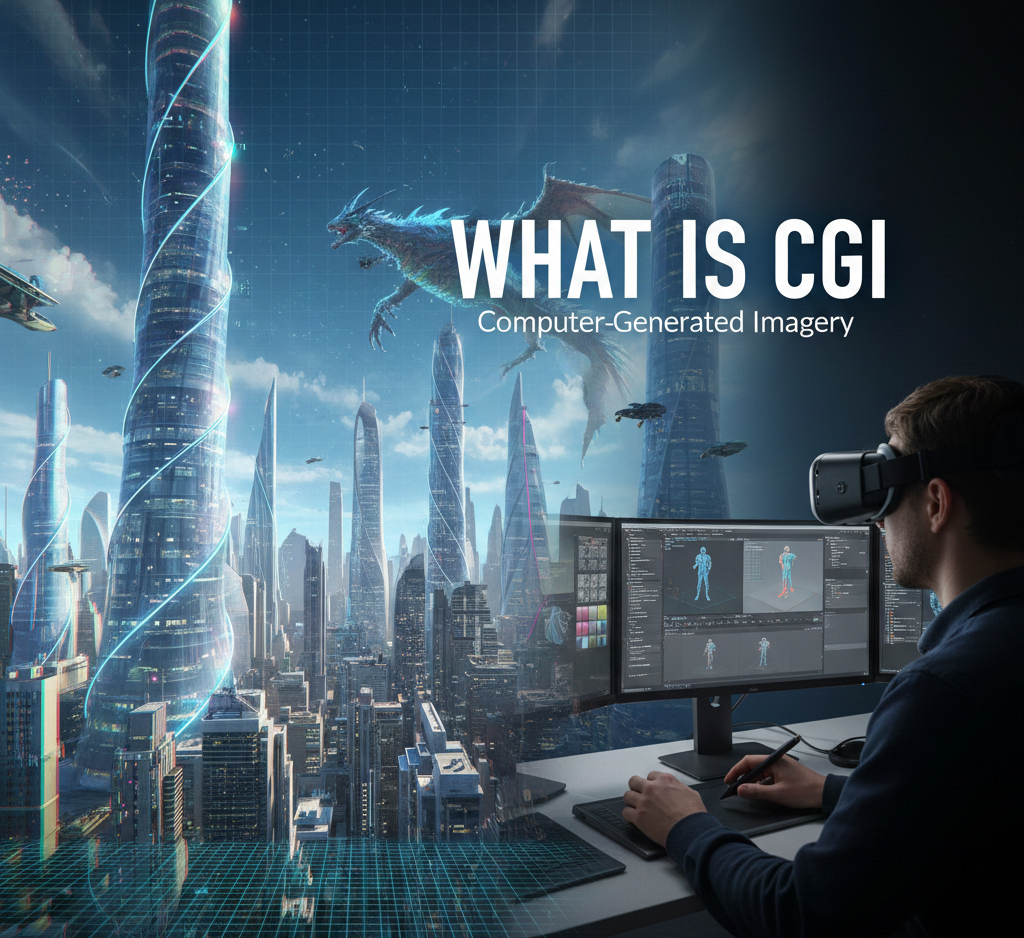
What Is CGI? & How It Works
In order to comprehend what CGI is all about, it is necessary to understand how it works. CGI relies on computer software to create models and animations of objects or scenes. Artists make models, and colors, lighting, and movement are incorporated into them to make them more realistic.
Typically, it begins with an idea/concept. Later on, 3D models are generated with the help of software. The models are then textured and animated. Final rendering then completes the process of turning data into high-resolution visual content.
All this enables artists to implement their imagination in forming creatures, designing futuristic cities, or even visualizing practical product designs.
History & Evolution of CGI
In learning about what CGI, one might be interested in knowing its history. CGI began as a primitive technology that created simple graphics. However, as time went by, the advancements in computer speed and graphics software improved CGI.
In the past, CGI was used mainly in science fiction movies. Today, it is used in almost every sector. Technological advancements have made it more accessible, detailed, and realistic than ever.
Applications of CGI in Diverse Sectors
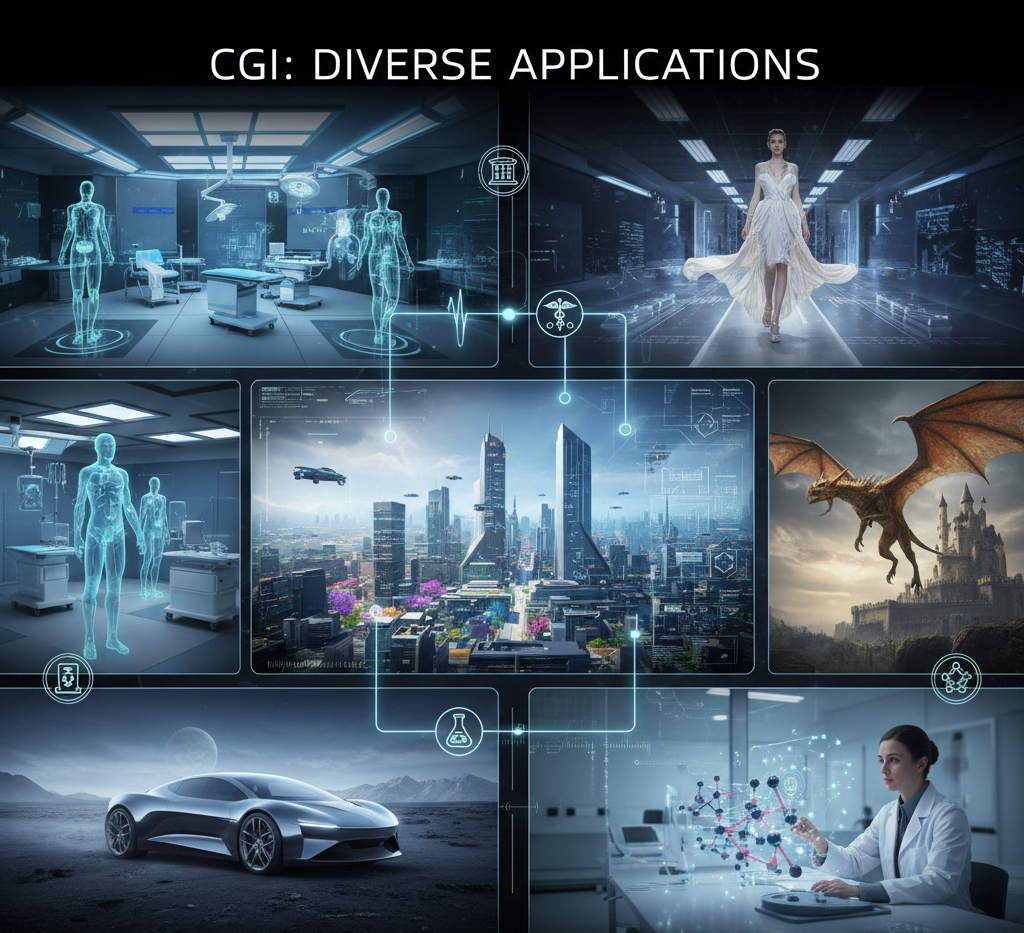
To better understand how CGI works, it would be helpful to see where it is used. CGI can be used for purposes beyond film productions.
CGI in Films and TV Series
The most common use of CG imagery is in films. It assists in shooting scenes that are unachievable, difficult, or too expensive to do. Explosions, fictional figures, space, and action are common practices that require CG imagery.
CGI in Advertising and Marketing
In advertising, CGI is used to produce compelling visuals to capture attention. Products can be demonstrated creatively without having to physically shoot. CGI assists brands in telling their story.
Computer-Generated Imagery in Video Games
Video games extensively use CGI. All characters and animations used in video games have to be computer-generated. It helps players experience an interactive environment.
CGI in Architecture and Real Estate
CGI is utilized to generate 3D imagery of the structure, enabling the client to clearly view the structure before its implementation. CGI stands for Computer-Generated Imagery.
CGI in Education & Training
Educational videos rely on CGI to simplify complicated subjects. Medical instruction, science experiments, and product demonstrations are some of the fields using CGI.
CGI vs VFX
People are often misled when learning about what is CGI and what is VFX. For example, CGI stands for creating images using computers, while VFX stands for adding these images to actual footage.
CGI refers to the production of visuals, while VFX refers to the combination of the visuals and the live action footage.
Advantages of Employing CGI
One of the strengths of CGI is that there is creative freedom. There are no limitations in reality. Whatever is in one’s imagination is achievable in CGI.
Another benefit is cost-effectiveness in the long run because scenes deemed high risk, large sets, or reshoots will not be necessary through CGI.
Modifying CGI is easy, too. Changes can be implemented with no need to re-shoot scenes. This increases the usability of CGI.
Why CGI Matters in Today’s World
In today’s digital world, visuals have become a key component of all communications. An understanding of what CGI is will assist you in realizing just how crucial it is. CGI assists individuals or businesses wishing to be different in today’s market.
The growing use of digital platforms and content has made CGI assist in creating eye-catching and high-quality visual content.
Possible CGI Applications
The future of CGI appears very bright. With technologies like Artificial Intelligence, Virtual Reality, and Augmented Reality, CGI will be more realistic and interactive.
With the increasing levels of technology, CGI is poised to continue making waves in the way stories are presented to consumers.
Conclusion
With a clear understanding of what CGI is, the importance of CGI in the modern visual era should be evident. CGI can make imagination a reality, making it capable of providing a visually impactful performance. Framexentertainment is a full-service visual production house dealing in Ad Films, CGI & VFX Videos, UGC Ads, Music Videos, Fashion & Product Shoots, Corporate Films, Documentaries, and Short Films.
Frequently Asked Questions (FAQs)
What does CGI mean?
CGI is the creation of images or videos using computers rather than camera equipment.
Is CGI only employed in cinema?
No, CGI is used in advertisements, gaming, education, architecture, and various other applications.
What software is utilized in CGI ?
CGI is produced by various computer softwares intended for modeling, animation, and rendering.
Is CGI better than real shooting?
Both are of equal importance. CGI can be used when it is difficult, costly, or impossible to shoot.
Can CGI really become realistic?
Yes, modern CGI has gotten to a point of realism that it has been difficult to distinguish between it and real footage.